
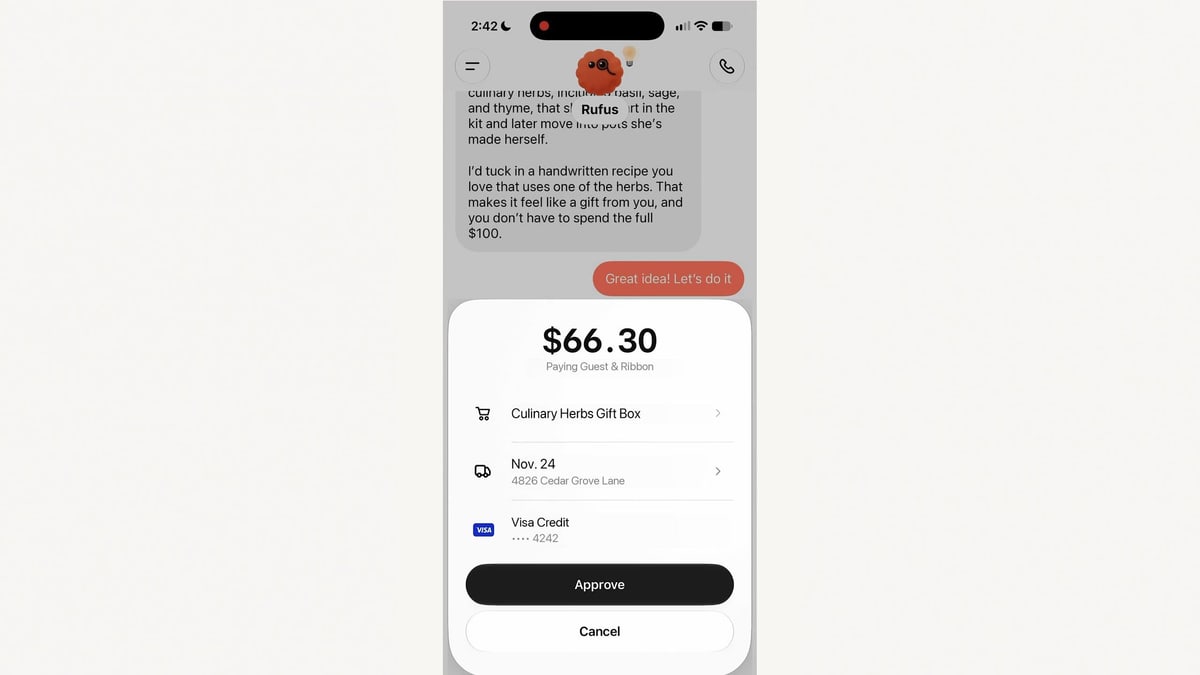
On Nov. 13, OpenAI introduced ChatGPT Wallet, which lets OpenAI's AI agents, which it calls dots, pay online stores for the people who use them. Dots are AI agents: AI that can carry out tasks on its own, such as using apps and websites, instead of only answering questions. OpenAI built Wallet with American Express, Mastercard and Visa. OpenAI says many of ChatGPT's 1.2 billion weekly users already use ChatGPT to research and compare products, and Wallet is meant to let a dot finish the purchase.
A user adds a card once, in a secure form. Before each purchase, Wallet shows the store, the items, the total and the card, and the user approves with a check such as Face ID or a fingerprint on a supported device. The payment network then provides a payment token: a stand-in card number, security code and expiration date. The purchase is still charged to the real card. OpenAI says Wallet does not share the real card details with the store or the dot, and users keep their card's rewards and their protections for eligible disputes with a store, such as over a faulty item.
Wallet is rolling out first to ChatGPT Pro subscribers in the U.S. who are 18 or older and have a U.S. billing address. OpenAI says it is reaching eligible users gradually, so some may not have it yet. It works only in conversations with a dot, not in regular ChatGPT chats, ChatGPT Work or standalone Codex threads. It takes eligible U.S.-issued American Express, Chase, Mastercard and Visa cards. Chase cards work only for the primary cardholder, and virtual cards can't be added at launch. OpenAI says Wallet may not be able to check out at every store, and some sites may block it by mistake. OpenAI has published a guide for businesses. It is also working with payment companies including Stripe and Adyen and fraud prevention firms including Forter and Signifyd, so their systems recognize real purchases made by agents rather than decline them.
Under Wallet's terms, returns, refunds and most order problems go to the store or the card issuer; OpenAI says it handles Wallet errors and purchases that differ from what the user approved. The terms say the store is the seller, and OpenAI is not a bank or card issuer and does not hold the purchase money. OpenAI does not decide or pay for refunds or card chargebacks, unless the law requires it, and the terms say it takes no responsibility for purchases made with Wallet. OpenAI's usual dispute and arbitration terms also apply to Wallet. The terms warn that AI systems can make mistakes and tell users not to approve a purchase unless the details are right. An approved purchase can still be turned down by the bank or the store, OpenAI may limit or block purchases, and a user who agrees to a recurring plan may be charged again by the store under that plan.
OpenAI says it does not receive the full card number or security code; a separate company collects those in the card form. It keeps records of each purchase and approval, and collects details such as the device used and its approximate location for security and fraud checks. OpenAI says it does not sell Wallet data or share it for targeted ads, and that it does not receive the face or fingerprint scan itself when the check is done on the device.
OpenAI says it expects that, over time, users will be able to approve their dot's purchases ahead of time, within limits they set, such as a spending cap, a type of purchase or a time period. Wallet's terms already mention letting ChatGPT approve purchases in advance, though OpenAI has not said that option is available today. According to a news report, OpenAI is not taking a cut of purchases for now. OpenAI says it will expand availability as it learns from early use, but has not said when Wallet will reach other plans or countries.