
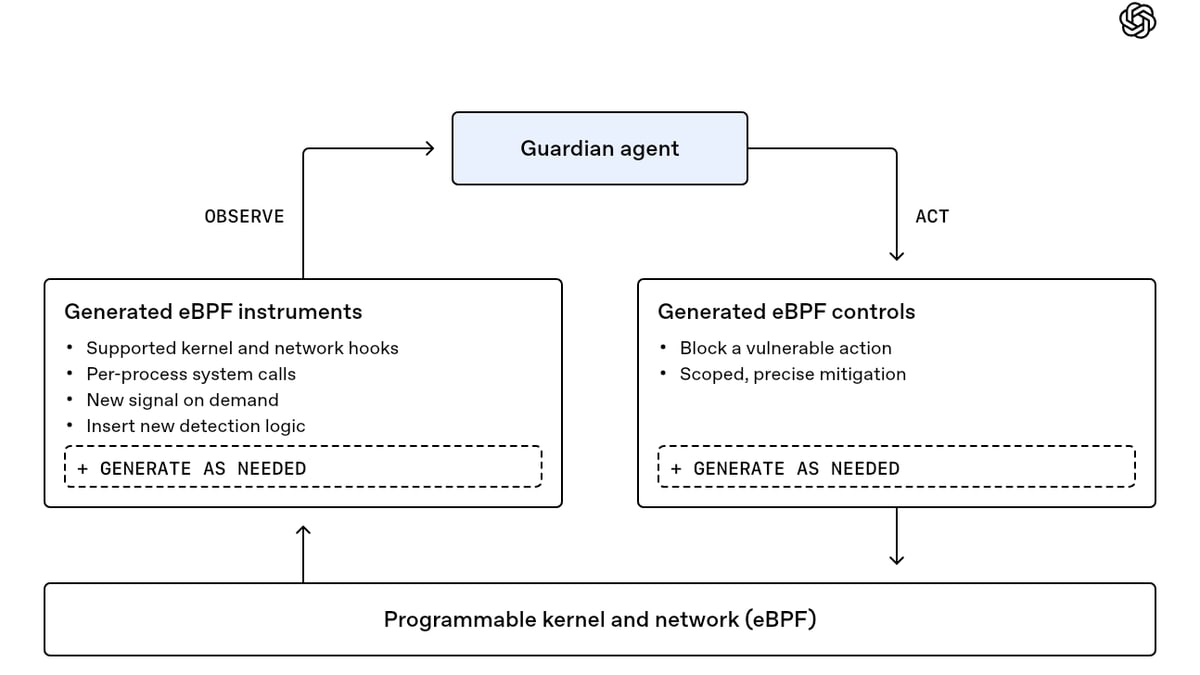
OpenAI and Cisco on Monday, Nov. 23, released Shirudo, software for the gap between learning about a security flaw and fixing it. It is open source, free for anyone to use, study, change and share. OpenAI says testing and installing a fix, called a patch, can take days or weeks. Simply switching off the step inside Linux that an attack uses could take a service offline, OpenAI says, because normal requests may rely on that same step. Shirudo is a rewrite of Tetragon, a security tool that Isovalent, now part of Cisco, made open source in 2022. Tetragon already powers a feature that blocks attacks on unpatched flaws in Cisco's own products.
Shirudo lets a team load a temporary safeguard, which the companies call a shield, onto a running Linux computer without restarting it. Each shield targets a vulnerability, a weakness in software or a system that an attacker could use. It is meant to block the step the attack relies on while letting normal requests through, and teams can test that before it goes live. Shirudo is built on eBPF, a Linux technology that lets small programs run at set points inside the operating system. The companies say AI agents can use Shirudo to study a flaw, write a shield and test it, while security teams control what gets deployed, though Cisco's engineers say the rollout step can be set up to run with more or less human involvement. An AI agent is AI that can carry out tasks on its own, such as using apps and websites, instead of only answering questions.
The companies tested it on Java4Shell, a serious flaw in the part of Java that reads Base64, a common way of packing data into text. On Nov. 17, the U.S. cybersecurity agency CISA urged organizations to patch it immediately, saying specially crafted input could crash Java and let an attacker run their own code on the machine without logging in. In a controlled test, OpenAI says, its Codex coding AI wrote a shield that added a check on that input to a running copy of the Elasticsearch search software. The shield rejected the attack while the program kept running. Cisco's engineers say this shield was not an eBPF program but a small piece of Java code slipped into the running program, and that it "appears to be effective". The project's documents say a Java program has to be set up to load Shirudo's shields when it starts.
Cisco says Shirudo also blocked attempts to exploit a recent PHP flaw in testing. The project's own notes describe its shield for that PHP flaw as a fence, not a fix: an attacker's code can still run inside the program but can't leave a PHP file behind, start another program or connect out, and the computer still needs the PHP update.
Each shield carries a digital signature that the computer checks before loading it. Cisco says that check still works even if an attacker has gained administrator access, and the project's documents add that this holds as long as the attacker doesn't have the operator's signing key. That protection covers only shields loaded into Linux itself: a Java shield runs inside the program it guards, which can undo it, so it is no barrier to an attacker with administrator access. The signature shows who made a shield, not that it works, and the project lists security gaps it has yet to close. A security chip in the computer, a Trusted Platform Module (TPM), helps keep a record, which can be checked, of each protection added or removed, so operators can confirm that their systems meet their security rules.
The project calls itself pre-release. Computers in everyday use need a version of Linux with Shirudo's own changes and a TPM 2.0 chip. The quick trial instead runs in a virtual machine, a computer simulated in software, with a simulated chip. Its documents warn that it trusts the core of Linux it runs on, so an attacker who already controls that core could get past every check, Shirudo's included. The documents say its shields can block a known weak spot until a fixed version is installed, but do not replace the protections built into Linux that make such attacks hard to pull off.
The results so far come from the companies' own tests, and they are asking others to show where a shield breaks normal traffic. Other companies already offer similar stopgap protections, according to a news report, which adds that Shirudo could raise demand for Codex. The companies say they want tested shields to come out alongside future flaw warnings, and they plan a technical webinar on Dec. 15. The code is on GitHub under the BSD 2-Clause license.